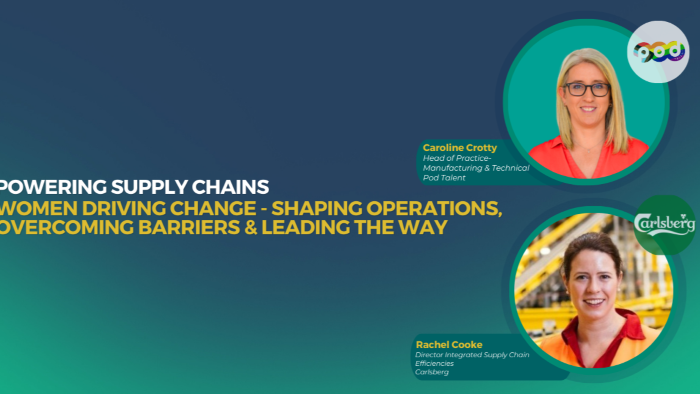
As 2026 gets started it is my pleasure to share the latest instalment of my Q&A sessions with female leaders in Supply Chain and Operations. I had the pleasure of catching up with Rachel Cooke FREng last year, and not only congratulating her on recently having been elected as a Fellow of the Royal Academy of Engineering, but also chatting about her thoughts on the industry and how things are changing.
As always, interested to hear your comments and thoughts on any of the topics outlined- or other areas you would like us to probe more on in future conversation.
What inspired you to pursue a career in Supply Chain – particularly engineering? I chose to pursue a degree in chemical engineering because I wanted to combine mathematics and chemistry, I wanted something practical. My father’s a chemical engineer, so I had him as a role model who could explain what the job was about, he got to travel, and he enjoyed the job so I figured I would as well… And then once I studied chemical engineering, that’s when I discovered FMCG as a particular way I could take my career. I started looking at graduate schemes and I found Cadbury’s, and I love chocolate- they didn’t have a chemical engineering scheme but had one in manufacturing so that’s how I got in to operations.
What advice would you give to any young women considering a career in Supply Chain? I think you have to do a lot of research. Find a product that you’re interested in and you’re wanting to work on, different industries have different pay scales and also locations- if you are interested in oil and gas for example as I was then you can end up working in some more remote locations.
It is fantastic now that you have shows like Inside the Factory and YouTube which can give you a real inside into the day to day running of a site. I think it’s good to go in with open eyes as to what you’re going to be doing every day and the constraints. And then obviously the most important thing is to find a company with kind of similar values to you have and the right culture.
Where do you see the industry going in 5 years and what skills do you consider will be most important then? We have all this fantastic technology and I’ve been really fortunate in my career to see things like Industry 4.0 and the introduction of IOT, it’s gone from early trials when I started out to now being business as normal. Technology is great and it follows a set of rules and process… but people are different, right? And getting them to adapt and embrace these changes and this new way of doing stuff, that is the biggest challenge… it does follow logic, whereas people don’t always.
Change management will remain a key skill- technology will continue to evolve and even if the workforce is becoming more ‘digitally native’ there is still a human element of sticking with what you know and needing to support people through the changes.
Were you offered support or mentorship as a woman in this space, and what impact did it have on you? I think it’s really important, actually, that it was forced on me, straight out of university as I might not have had the confidence to go and ask for a mentor, so it was good to be told to go and find one.
I’ve found that they have good ideas on how you want to take your career- I remember one particular example that I said I’d wanted to go and live abroad and at Cadburys there was a huge investment in Poland, and I mentioned to my mentor that I’d like to work on the project. My mentor knew the woman running the project and suggested I send her an email - I think if I hadn’t had a mentor, I would never have sent that email. So I think it is important sometimes just to vocalise what you want and even if you don’t get it then it won’t do any harm asking for what you want.
I try to mentor myself now- both men and women, I think it is important that men see women as people who can be in a position to be a mentor – most of my mentors have been men as that was who has been more senior, so it’s good for senior women to normalize that we can be mentors as well.
Have you noticed a shift in how companies support women in supply chain? What still needs to change? It’s been a complete change. When I started out, it wasn’t talked about at all… now it certainly becomes talked about a lot more. When I first started out there were no employee resource groups, and nobody really talked about DEI. As I have moved companies it is definitely something that is more at the forefront. It can be difficult as no woman wants to feel she is included as part of a quota, but I do think that it is important to measure and maybe having quotas at shortlisting, so you are getting a good variety of people into the recruitment process it helps to open the playing field. For bigger companies having targets around women in leadership positions is useful as it helps to drive inherent cultural change.
What barriers, if any, have you faced as a woman in the industry? How did you push through them? I don’t know if they are specifically barriers but my experience has definitely been very different to if I’d been a male… you’ll be the only woman in the meeting or the only person in a business hotel for work travel… you get microaggressions, you get more overt comments… you do experience a lot from being in the minority – sometimes it is important to call it out but other times you have to ignore it.
Personally, what do you think companies could do to attract more women into technical functions of the supply chain? Having women who are vocal, who are enjoying their role, talking about enjoying it, I think that’s important because then people see someone like them. It doesn’t just have to be women but people with different characteristics – if you see people who are similar to you doing something then you can begin to imagine yourself doing it too.
Is there a stereotype about women in technical or operations roles that you would like to break? I think at the level I am at those stereotypes don’t show up quite so much but sometimes if I go to universities to discuss careers and I’m wearing pink or a skirt or something they are sometimes a bit surprised. Things like dress codes are more relaxed now so you can show a bit more of your individuality.
Are there unique strengths women can bring to supply chain that can go under-recognised? There are no strengths unique to women, but they can be more organised, more empathetic, and more determined. This is because it takes a lot of resilience to get to a senior role in SC as a woman, so the ones that are there really want to be there.
What does true inclusion mean to you – not just diversity, but inclusion? True inclusion is when you feel you can be yourself and be valued for who you are and the people around you can also be themselves and feel valued and respected.
Are there any communities or networks you would recommend to other women in STEM or supply chain roles? The community I've worked with the longest is my professional engineering body, the Institution of Chemical Engineers, and I've recently been elected a Fellow of the Royal Academy of Engineering.
Whilst women's networks are important, and particularly shown to benefit those who play an active role in their organisation, women should look to play a part in the same networks as men. I'd recommend looking for communities related to your profession, ideally active in your local area, although virtual networking is growing and increasingly convenient if you travel a lot.