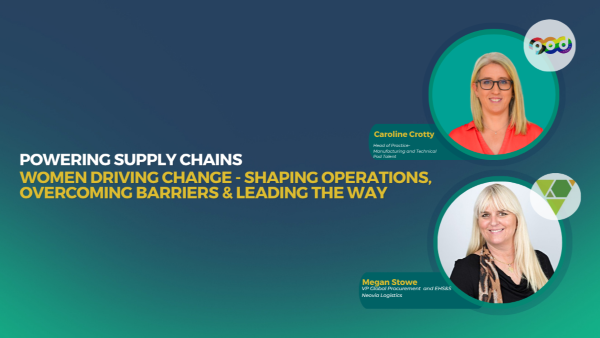
Great to be back sharing another in my series of Q&A sessions with female leaders in the Supply Chain. Megan Stowe and I were introduced through BOOM Global Network - showing the power of building networks, and it was great to find out a bit more about how she found her way in to supply chain and found her voice - despite sometimes being the only woman in the room. We covered the rise of AI and the continuing need for critical analysis and influencing ability- a topic that has come up in everyone of these conversations which I have had in recent weeks. As always would love to hear your feedback and any thoughts on the topics covered.
What inspired you to pursue a career in supply chain?
To be honest, I kind of just fell into it. But once I fell into it, I really loved it. I think there are so many different aspects and new challenges to solve. The ambiguity and the fact there's so many different parts in the supply chain, there's sustainability, procurement, transportation, operations, there's so many different areas. In terms of how I got to procurement - there was a lady who was our Asia-Pacific Marketing Manager and they were looking for somebody to run Asia-Pacific Procurement. I really didn't know much about procurement at that time… I thought, why not, right? It's something new, it's something I can learn. From there, I went into IT procurement, marketing procurement, logistics… and then sustainability became something really big. I've always been passionate about environment, especially the social side of things… human rights, how we engage employees and the community. So that's how I ended up building my career in the wider supply chain.
What advice would you give to young women considering a career in supply chain?
I think, go for it. There are so many different aspects, from Operations, planning, transportation, procurement… every day is different, there are so many problems to solve, and strategies to implement. Go and embrace the ambiguity and the challenges, because it is very rewarding. I always believe you learn outside your comfort zone… you learn so much, and then you flourish in that, and you jump into something new and exciting. So I would say go for it.
How do you see supply chain evolving in the next five years, and what skills will be important?
I think it's moving away from a cost and efficiency type industry to more resilience and response to speed… because of disruptions and geopolitical factors. People are trying to be more proactive than reactive, looking at multi-source ways of doing things. With AI being embedded more and more, it's taking away a lot of the mundane activities so we are reaching a point where humans will be used for exceptions, trade-offs and judgment calls.
Sustainability is going to become far more embedded… companies will be looked at not just on cost and service but environmental and social outcomes. Skill-wise, it's not siloed expertise anymore. You’ve got to look end-to-end. Data literacy is key. Change management and leadership as we move to more automation. And influencing is going to be a huge skill. AI is a good tool but you still need judgement to make decisions and we are not there yet where AI can provide that.
Have you had mentorship, and what impact has it had?
I've had mentorship. Some of my best managers have been my mentors as well as coaches and guides. They taught me about believing in myself, learning to speak up and being your authentic self… you can't copy someone else’s style. Be confident in your abilities and speak up. I believe we all bring something different to the table and you can’t just try and act in a certain way because someone else does- that might not be right for you
Have you seen changes in how companies support women in supply chain? And what more could be done in your opinion?
I think there definitely has been a shift. I've been the only woman in the room many times or the only person from a different country- there are different types of diversity for sure. There are a lot more senior women coming in and more women generally working across the supply chain as a whole. I have even seen it with advertisements for roles – moving away from the traditional long list of requirements in a tick box- which we know women will tend to veer away from if we don’t tick all the boxes.
Having more women present in the recruitment process is also helpful- visibility is key. Creating dedicated career programmes for women with mentors in place helps to raise the profile internally and showcase female leaders across the supply chain.
How do you overcome barriers like being the only woman in the room?
It can be intimidating being the only woman in the room I have found that reminding myself you are there for a reason is key- you are the expert in your own field, and sometimes it is just about taking a deep breath, sit back and listen first. Listening is a key skill. I don’t speak for the sake of speaking. I gauge the room, and when I have something valuable to say, I say it.
Be confident you were brought in for a reason… and use your own style.
Are there stereotypes about women in logistics?
Yes, but the industry is changing. It's moving away from being seen as physical, operational and male-dominated. There is more to the logistics industry for instance now than the classic ‘trucks and warehouse ’ as we said. Logistics is more than transportation and warehousing… there’s solutions design, procurement, sustainability, risk, digital transformation.
We need to highlight the strategic side of logistics more. You don’t only need to be driving heavy machinery and moving boxes- although of course you can if you want to, but there is a lot more to it. With automation technology and warehouse design technologies- there is no barrier to anyone joining the industry.
What strengths do women bring to supply chain?
I think emotional intelligence. We are more collaborative, we build relationships versus being transactional. Women do bring a different perspective to things- those skills- collaboration, influencing, relationship-building- are going to be very important in the future.
This can be a generalization but women do tend to be good at building relationships creating strong collaborative approaches. Listening is an under rated skill- you don’t need to be the loudest person in the room and I think that style is hopefully not as prevalent anymore but you do still see it sometimes.
What does inclusion mean to you?
Inclusion is listening and understanding. Everyone deserves to be heard. Different perspectives bring better, more rounded decisions- even if it takes longer. It’s not just gender- it’s diversity of thought. By not listening, you could miss something really important.
Are there any communities or networks you recommend?
Of course Boom is one- I really enjoy that. Also sustainability, logistics, procurement functional groups- they all have ‘women in’ areas which are useful to explore. It’s important to build your tribe - people you can learn from, connect with, and support each other. Sometimes it is face to face, but more often these days it is online- which makes it more accessible.