
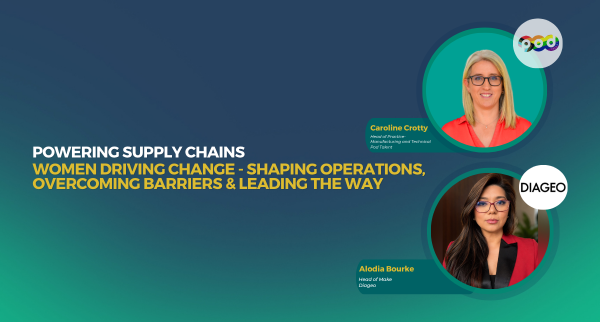
In my latest Q&A episode it was great to connect with Alodia Bourke to discuss her journey in the field of Operations - from starting out on the shop floor to leading regional and strategic projects across large scale FMCG companies. We covered all sorts of things from the rise of AI through to the importance of mentorship and pushing yourself out of your comfort zone! It was a great chat as always and hopefully you will enjoy reading the interview.
What inspired you to pursue a career in Supply Chain—particularly your technical specialism?
I came into Supply Chain starting on the shop floor. I had just completed a Food Science/Technology certificate. One day in class we had the head of Quality drop in to encourage the class to apply for roles as there was a greenfield site being built by then Kraft Foods. My friend and I thought why not let’s see how far we can get through the interview process. After 4 rounds of interviews, a psychometric test we both made it. We had a choice of either going into the lab or staring on shop floor.
I chose the shop floor as it piqued my curiosity as to how a new site which looked like a giant Go Cart facility as it was empty and just polished concrete would look like with equipment and products.
I started as a QC learning all the technical aspects of product, process and vertical start up.
I was a sponge and I was lucky to have managers / leaders who so my curiosity and feed it, throwing me in challenging technical roles from Process Improvements to Production Supervisor.
It was in the Production Supervisor role that helped me find my passion using my technical knowledge to teach / mentor people along with learning to lead and manage people.
Reflecting on my diverse experiences, I view my career in SC as a journey of mastering technical skills and applying that expertise to support individuals and organizations in my leadership role within SC. Having these technical skills has enabled me to support my teams and organisations.
I personally think SC is one of the most exciting and rewarding function to be in- there is nothing like it.
What advice would you give to any young women considering a career in Supply Chain?
Go for it. Women bring a valuable balance of intuition and data-driven thinking. Leadership today requires both IQ and EQ, and many women naturally bring strong emotional intelligence into leadership roles. I've observed different leadership styles from men and women, and found people excel when IQ and EQ are combined.
It’s important not to feel like you have to conform to a traditional leadership style. Early in my career, I tried to lead in a way I thought was expected, but it didn’t align with who I was. Over time, I learned to lead authentically. I do me.
Also, build your confidence, seek opportunities, and don’t stay in your comfort zone. Growth comes from taking risks. So yes ultimately go for it- it’s a very exciting and satisfying career path.
Where do you see the industry going in 5 years and what skills will be most important?
Right now in the age of AI, digitalization, as I see it as similar to when the internet was first introduced. There were the early adopters and the laggards.
Its important for industry to take a measured approach. AI has arrived, and without a solid grasp of how to incorporate it into our workflows, it's easy to fall behind.
I for one, am excited by AI, being able to take out non value added activities to help me focus on what is important versus spending hours trying to analyze data / create reports is one area I see where AI can benefit us.
AI has the capability with the right framework help support autonomy from shop floor to leaders.
Future leaders must:
- Understand AI and digital tools
- Balance technical and human skills
- Manage multi-generational teams
- Be adaptable to rapid change
As SC leaders we should at least have understanding of AI , because if we don't how do we lead our functions / teams with these significant change.
The speed of change happening is exponential but the training and awareness offered to Leaders/Managers is behind, we are still teaching people how to be leaders, which is important but not investing in training leaders in AI or Cybersecurity, apart from the odd mandatory compliance training.
We often tend to rely on specialised functions to tell us what we need not us understanding what we want our function to look like and asking our support functions, like IT, to partner with us to deliver our needs. Leaders moving forward need to use critical thinking but also be aware of what is possible and will to take a chance and try new things.
Were you offered support/mentorship as a woman in this space—and what impact did it have?
I was fortunate to have many great managers / leaders who fed my curiosity and gave me stretch assignments. My most memorable was one of my female manager pushing me out to work in another factory. I was quite comfortable in my role, I was learning, held various responsibilities, and remained in the same factory for eight years. And what she told me has carried me throughout my career she said to me when I was hesitant to move to take up a role in our sister plant " Alodia you can choose to have a job or a career, unfortunately a career requires you to get out of comfort zone and take a leap into the unknown"
Since then I have applied that litmus test every time I start feeling comfortable I ask myself this question and often when I am coaching others on their career I pose that same question to them.
As I have progressed over the years, for me I recognise the importance of support and mentorship, so if there wasn't a program offered I would seek it or create the environment for it. Just because there is no formal program doesn't mean you can't create one. I am a big believer of the quote " if there isn't a door , then open a window"
Those early years of mentorship has made an impact to me and as a leader if I can pay it forward and help someone then I have fulfilled my purpose.
I think its also really important to think about sponsorship not just mentorship- who is speaking about you when you aren’t in the room- putting your name forward, championing you- these people are essential to career success- hard work along won’t always gets you recognised so you want to have a network who see your value and bring it to the fore at the right times.
Have you noticed a shift in how companies support women in Supply Chain? What still needs to change?
I think there has been a lot of work done to have women in Supply Chain, but definitely there still need some work to be done. As women we are nurturers so its natural for us to feel we have to do everything otherwise we are seen as incompetent, I think there are still some unconscious bias that still needs to be broken down. We talk about work / life balance unfortunately in SC there is no such thing , I saw a clip from the Ex CEO of Pepsi Indra Nooyi regarding work life balance the message was about "juggling priorities" I cannot agree more.
Speaking from personal experience I know that it my earlier years I felt I needed to be super woman, but now I know better that it is not sustainable and its a fast track to burn out.
So I think the space where organisations can support and not just to women SC leaders is having the framework to create the environment to recognise and prevent burn out.
Organisations need to:
- -Move beyond token diversity targets
- Create environments that prevent burnout
- Focus on genuine inclusion, not just representation
- Support flexible career paths
What barriers have you faced as a woman in the industry?
Earlier in my career, I encountered “boys club” environments and stereotypes. For example, I was initially told I couldn’t perform certain roles due to being female, in one particular case on a cheese production line I had to fight for months to be given the opportunity to join the cooking line- the physical process wasn’t designed to make it easy for a woman to do, but once I was given the opportunity I saw quickly that there were ways I could improve the process through multi tasking and planning ahead the next phase of the process- something I was used to doing at home as a working mother. I pushed through by proving capability and improving processes and in time we worked on solutions around the physical challenges.
As a leader, I also faced challenges with individuals resistant to female leadership. I learned to adapt my leadership style, build trust, and understand different personalities. Working with people there is not a one size fits all approach and I learned that I need to be flexible in my approach, but also stand firm when needed- on occasion teams tried to push boundaries to see what I would put up with and I had to have some challenging conversations- but ultimately we were all on the same team so needed to get on board.
What can companies do to attract more women into technical Supply Chain roles?
I think SC from an outsider looking in, regardless if whether you are female or not , can look like a wild roller coaster ride, to some it can look appealing and they want to jump in but to most its like "why would I want to go there?"
Having stepped out of SC into other functions, I can say SC is one of the most rewarding functions to be in. There is not a dull moment and when it comes together it is one of the most satisfying feelings.
Initiatives such as Graduate Programs target younger women, but what about looking at Traineeship or Internship for mature women ? They bring a mature approach, they may not have the technical skills but if they have the right EQ and with the support of their functions around them they can still lead and this is a core demographic that sometimes end up dropping out of technical roles due to increasing demands outside of work.
Companies need to think about how they can continue to capture the imagination of generations that don’t want to sacrifice their whole lives to their career – increasingly the work force is looking for balance- which can be hard in technical roles, but there are ways to make things more appealing.
- Promote the rewarding and dynamic nature of Supply Chain
- Offer opportunities beyond graduate programs, including for mature women
- Provide support structures for career transitions
- Create inclusive environments with practical facilities and support
Is there a stereotype you would like to break?
Women are too emotional - that often comes with negative connotations. I think being emotional is a good thing. being able to pick up when someone needs that extra time during a 1-1 and digging deeper beyond the KPI is something I personally think is a good thing.
Through doing that I have been able to build strong relationships I get to understand the person and they get to understand me as a person and not just a leader/manager. When you have that kind of relationship with people, when there is an issue or hard message to deliver it is a lot easier and doesn't come cold or impersonal.
As I see it we are all humans first and foremost.
What does true inclusion mean to you?
- True inclusion goes beyond representation. It means:
- Having a voice and influence
- Valuing different leadership styles
- Providing equal opportunities
- Creating psychological safety
As a female leader in supply chain I’ve seen first hand that diversity metrics alone don’t create meaningful change. Representation matters- but representation without a voice, opportunity, and influence is simply optics.
To me, true inclusion is when women are not just present in a room but are actively influencing decisions and not waiting to be asked.
Different leadership styles are embraced, situational leaderships and not just the traditional norm. For me true inclusion means redefining leadership. It means recognising that strong leadership can look like empathy, collaboration, resilience and adaptability, not just decisiveness and control. These are not "female traits" they are leadership traits that strengthen teams and deliver results.
Diverse perspectives are sought early, not validated after decisions are made.
Opportunities for stretch roles, critical projects and advancement are equitable
Psychological safety exists - where speaking up is encouraged and not risky.
Supply chain is complex, fast moving and often operationally intense. Best outcomes don't come from uniform thinking - they come from diverse experiences, challenging assumptions and collaborative problem solving. That to me only happens in truly inclusive environments.
Moving beyond diversity to true inclusion, we unlock potential. not just for individuals but for teams, organisations and entire supply chain.
For me when I look at organisations to join this is one area of focus I look at, and if they have it they have a competitive advantage and its the environment I want to be part of and contribute to.
Are there any communities or networks you recommend?
One of the things I did for myself is using the feedback from my managers, peers and self assessment to work out how can I improve, earlier years it can be confronting but one thing I have learnt feedback is a way of holding a mirror up and seeing the good things and that not so good and you have control of what you do with it. You can choose to ignore it or do something with it.
For me I chose to do the self work and groups such as NAWO, AME networking with other women/men leaders has helped me a lot and when I mentor up and coming leaders I try to help by providing insights, because our role as leaders is creating more leaders for the future. For me that is the value I bring to the table and my purpose as a leader in SC.